MAP
Grounds Map and Visit Duration
Tap the numbers on the map or the list to read the history and meaning of each place of worship, with text and photos.
Please buy your ticket at the Nanjo City Regional Products Center. Tickets cannot be purchased at the site entrance. The green mark on the map is the Products Center (free parking). See Admission and Access for details.
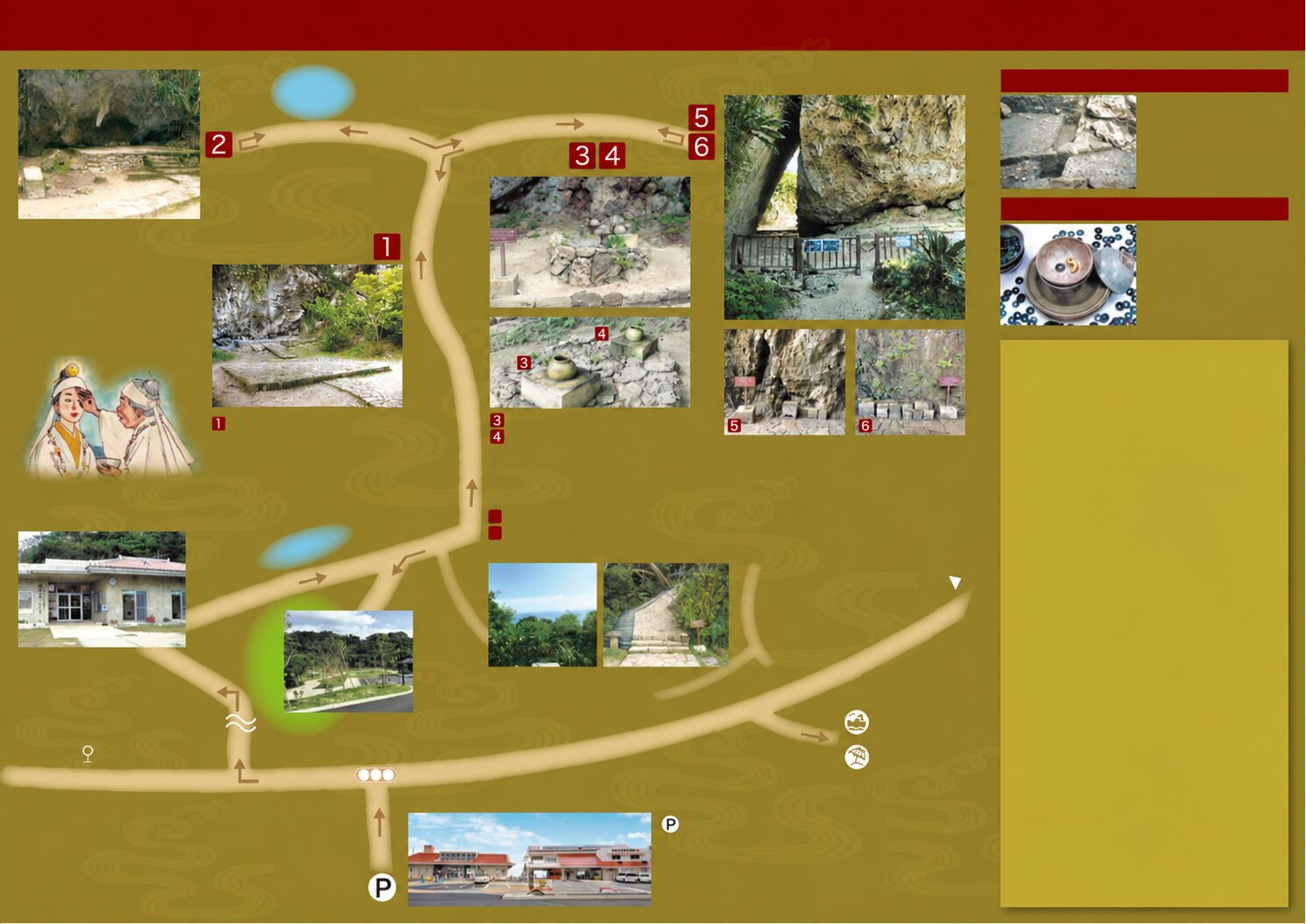 Sefa-utaki — The Six Places of Worship
Hodan-ike Pond
Park Pond
Park
Exit
Entrance
Sefa-utaki Entrance
Post Office
Route 331
To Yonabaru →
◀ To Yaese
Chinen Misaki Park ▼
Bus stop (for Naha)
Sefa-utaki-mae Bus Stop
To Azama Port (ferry to Kudaka Island)
To Azama Sun Sun Beach
The drainage channel before Sangui, confirmed by excavation
Artifacts excavated at Sefa-utaki (Nationally Designated Important Cultural Property)
Sefa-utaki — The Six Places of Worship
Hodan-ike Pond
Park Pond
Park
Exit
Entrance
Sefa-utaki Entrance
Post Office
Route 331
To Yonabaru →
◀ To Yaese
Chinen Misaki Park ▼
Bus stop (for Naha)
Sefa-utaki-mae Bus Stop
To Azama Port (ferry to Kudaka Island)
To Azama Sun Sun Beach
The drainage channel before Sangui, confirmed by excavation
Artifacts excavated at Sefa-utaki (Nationally Designated Important Cultural Property)
Glossary
Agariumai (the Eastern Pilgrimage)
A pilgrimage to the sacred sites of Chinen and Tamagusuku, where the creator goddess Amamikiyo is said to have arrived and settled. Because the region lies east of Shuri — agarikata, “the east” — the circuit came to be called the Agariumai.
Oaraori (investiture rite)
The rite in which the Kikoe-Okimi assumed the highest priesthood. After ceremonies in Shuri, she entered Sefa-utaki in Chinen and performed a series of rituals. Through the ubinadi rite — sacred water touched to her forehead — she is said to have received the divine spirit and become one with the gods.
Kikoe-Okimi
Meaning “the most renowned priestess,” the highest rank of priestess in Ryukyuan belief, held to protect the king and the whole kingdom spiritually. Royal women, such as the king’s sisters, were appointed; from the first (1470) to the fifteenth (1875), they carried the kingdom’s rites for more than 400 years.
Kudaka Island
Called “the island of the gods,” where rituals have been held since the Ryukyu Kingdom era. It is said to be the first island created by Amamikiyo and the birthplace of the five grains. Until the 17th century, successive kings of Ryukyu made a pilgrimage to the island every two years.
Approximate visit duration
A visit inside the utaki takes about 30 minutes; from the entrance to Sangui is about 10–15 minutes. Including the walk from the ticket counter (Nanjo City Regional Products Center), allow 50–60 minutes in total.
An audio guide to the places of worship is planned for the forthcoming official Sefa-utaki app.